Documenting the development process of a “Dian Deng Water Bag Backpack”
I recently worked on a quite unique development project.
The client originally specializes in water-bag backpacks; this time, they have approached us with the hope that we can jointly develop a “unique” new product—by integrating lighting elements into the water-bag backpack, enabling it not only to hold water and be carried, but also to truly “light up” at night.
It may sound like simply “adding some lights,” but once you actually start working on it, you’ll realize that this isn’t as straightforward as just attaching light strips to the bag. Every detail—such as how the light strips should be routed, how the visual effect should be achieved, how different colors should be rendered, where the logo should be placed, and how the final product can look appealing while still being functional for carrying—requires careful deliberation and refinement.
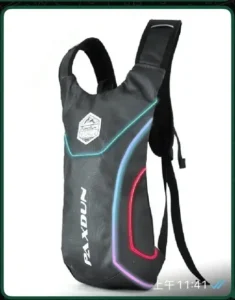
Figure ①: The initial lighting strip visual concept proposed by the client: three colored light lines—red, blue, and purple—which create a strong futuristic feel.
The client confirmed in the chat: “For this solution, we would like to retain three lighting lines with colors Red, Blue, and Purple; additionally, the lighting colors can be selected according to specific requirements.”
This step is actually crucial. For lighting products of this type, the lighting is not merely a decorative element; it is the “soul” of the entire product. The placement of the LED strip determines the product’s silhouette, while its color defines the first impression the product makes on the viewer.
Therefore, from the outset, our focus was not merely on whether it could be lit, but rather on whether, once lit, the bag would still appear as a complete product.
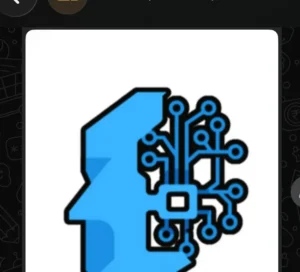
Figure ②: The logo that the client has confirmed for use. The client stated: “Please use this logo.”
After the lighting design proposal was finalized, the client sent over the brand logo, hoping to incorporate it into the product design.
The journey from a simple image-based logo to its final integration into a product involves considerations such as dimensions, positioning, clarity, and harmony with the overall lighting effect. The client may even ask whether PDF-format logo files can be provided—these seemingly minor details are, in fact, crucial components of the product development process.
When it comes to product development, I’ve come to realize that what truly determines a product’s final outcome is often not some “big idea,” but rather whether these small details can be implemented one by one.
Next is the most anticipated part: sample production.
When the sample came out, and I saw it actually light up for the first time, I felt quite a sense of accomplishment.
What began as just a reference image in a chat log, a logo, and a few descriptions of colors and lighting ultimately evolved into a physical product that can truly be worn on the body. The lighting extends along the contours of the bag; once illuminated at night, the product’s three-dimensional quality and futuristic vibe become immediately apparent.
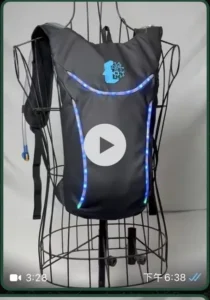
Figure ③: Actual appearance of the first edition sample; front view after the LED strip has been activated.
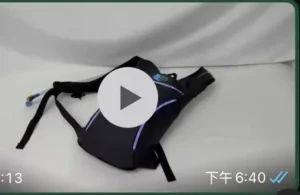
Figure ④: The sample in its flat-lying state allows for further observation of the LED wiring and overall structure.
Of course, producing prototypes does not mean that the project is complete.
One sentence in the customer feedback left a particularly strong impression on me: “The sample is ready, but there is one thing that is not yet perfect.”
This is essentially the most authentic state of product development: the first version of a prototype always marks the beginning of identifying issues, validating ideas, and continuing optimization.
From the customer proposing ideas, to confirming the lighting colors, then to finalizing the logo and producing samples, and finally seeing the product actually come to life—while this entire process may seem like just a few images and a few chat messages, it actually involves numerous rounds of communication, revisions, and implementation.
I really enjoy this process of transforming “an idea” into “a physical object.”
This is especially true for such unique products: the joy of development lies in the fact that the final product delivered to the customer is no longer merely what the client initially described—rather, it is the distinct identity of the product itself, shaped through continuous refinement of its design, structure, craftsmanship, and details.
For any product—from the initial idea to the final product—the most interesting part is often found in the process of “continuously improving it.”