The 76-Day Journey of the Bliss Jewelry Case
Client: Bliss LLC | Livermore, California, USA
Product: Book-Style Travel Jewelry Organizer
Chapter 1: An AI Design Nobody Dared to Touch
May 15, 2026. I received an inquiry from California.
The sender was Bliss, a women’s accessories brand just getting off the ground. Unlike most inquiries that ask “what do you have in stock?”, she sent several images and a candid admission:
“It is an AI generated picture based on my sketch and the design I wanted to have as a finish product.”
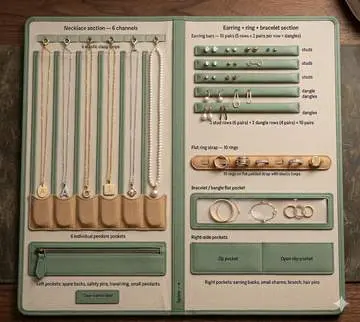
I studied the design carefully. A book-style foldable jewelry travel case, closed dimensions 19cm x 13cm x 5cm, Saffiano-embossed PU leather exterior, microfiber suede interior. The internal structure was extraordinarily complex:
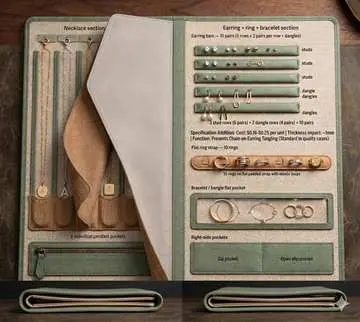
– Left page: 6 individual necklace channels with elastic clasp loops, 6 pendant pockets, zippered compartment.
– Center divider: Full-size flip page to prevent tangling between jewelry sections.
– Right page: 5 earring bars, 10-ring flat strap, bracelet pocket with transparent window, multiple hidden pockets.
– Hidden magnetic closure, spine rated for 500+ open/close cycles without cracking.
– Braided elastic throughout, must retain 80%+ tension after 500 stretches.
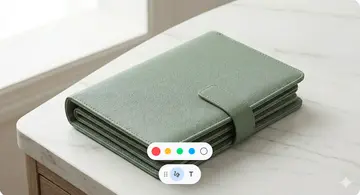
This was not a simple “copy the picture” job. This was developing a product from zero. I later learned DiPam had approached several suppliers before me. Either they said it couldn’t be done, or they quoted and went silent. She mentioned it herself: “I am asking for quotes and samples from few other suppliers as well.”
But her design was so meticulously thought out — after 10 years in the bag industry, I could recognize that level of intention instantly. This wasn’t a rough doodle. It was a product someone had really thought through. I decided to take it on.
Chapter 2: First Contact, First Quote
After the engineering team’s evaluation, I sent the first quotation:
| Quantity | Specification | Unit Price (FOB) |
| 300 pcs | 1 color | $9.85 |
| 500 pcs | 3 colors | $9.45 |
| 1,000 pcs | 3 colors | $8.95 |
Sample fee: $150 + shipping $40 = $190 total. Estimated sample lead time: 15-20 days.
Bliss was transparent about comparison shopping. She asked if the sample fee could come down to $100. She said: “We are looking for long term relationship with you and your factory.” I appreciated the honesty. We settled at $150.
On May 19, the first sample order of $205.38 was confirmed. Bliss sent her embossed logo and three target colors: Sage Green, Black, and Dusty Rose (later, blue would replace black).
She also made a mistake in her spec sheet — listing the open dimensions as 40cm x 13cm. I spotted it immediately: a single side is 19x13x5cm, so opened it should be 19x26cm, not 40cm. She corrected it and seemed genuinely impressed. I had a feeling: this was someone who respected attention to detail.
Chapter 3: Stitch by Stitch — The Grind of Perfection
Selecting Materials: Finding the Right Color Among Hundreds
On May 22, I sent the first batch of material swatches.
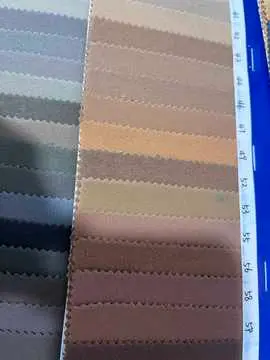
An entire swatch book — cream, light tan, camel, olive, charcoal, dusty rose, navy — dozens of colors densely packed. DiPam ultimately chose #42 for the inner flap color, complementing sage green, rose gold, and light blue for the three exterior colors.
But the blue turned out too dark in the first version. She asked for a lighter shade, noting “we actually liked the other side of the leather color for the blue” — she preferred the reverse side’s tone. This level of color sensitivity is rare in ordinary clients.
Structure: When Beautiful Designs Meet Brutal Reality
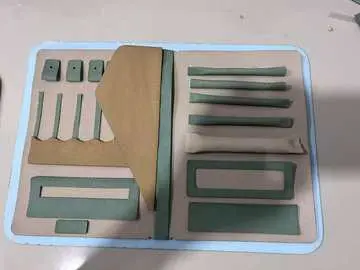
On June 10, when I sent the layout of freshly cut pieces, all the problems surfaced at once:
– Earring section: The design showed 5 rows, but you physically couldn’t fit 5 rows of stud earrings in that space.
– Bracelet section: The allocated space was too small — a real bracelet couldn’t fit inside.
– Necklace section: Not enough length. When you place a necklace, the chain bunches up.
– Center flap: She wanted a full-page flip effect, but the lid I made was too small.
Every issue required re-communication, re-adjustment. Earring rows: 5 → 4 → 3. Bracelet section: merged and expanded. Necklace position: shifted down. Zipper pocket: enlarged. Center flap: completely redesigned.
DiPam never lost patience. She said: “Would be best for both of us if the sample is exactly the final product.”
I replied: “Although it’s a bit slow, the product made this way will be perfect.”
That mutual understanding — it’s the thing I treasure most after all these years in international trade.
Chapter 4: The First Sample — Hope and Disappointment Intertwined
June 16. The first sample finally took shape. I took photos and sent a video.
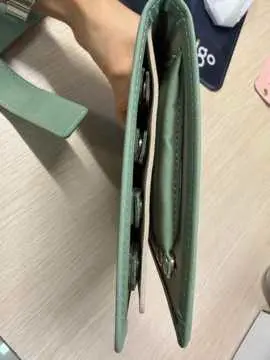
After seeing the video, she said: “It looks really good. We are very impressed with the look of it.”
But when the sample physically arrived in the U.S. on June 23, she and her partner had a long discussion. Then came the feedback:
13 modification requests:
1. Overall height needs +2 inches — necklace chains are crammed when placed inside
2. Zipper pocket too shallow — can only fit 2 safety pins
3. Earring buttons too bulky — looks unrefined
4. Necklace pocket material too stiff — can’t slide a finger in
5. Center divider flap too thick — doesn’t flip smoothly
6. There’s a chemical scent — needs to be addressed
7. Blue color too dark — prefer the lighter reverse side
8. Black marks inside — machine grease from hand sampling
9. Earring section: reduce from 4 rows to 3 — need space for dangling earrings
10. Add elastic band in chain section — to keep chains in place
11. Bracelet section needs to be larger
12. Center flap needs to be stitched in the middle — to cover entire earring/ring area
13.Bottom of right page needs to be sealed off
An ordinary supplier might have walked away at this point. I didn’t.
Chapter 5: If It’s Not Perfect, Start Over
June 24. I opened a second sample order — $77.18, for another round.
The second round was even more tortuous. On July 8, the craftsman misunderstood the design requirements, and the entire sample was wrong. Necklace pocket dividers, zipper position, button style — all of them were off.
I had the craftsman take it all apart and start over.
I told Bliss: “I checked the communication records, and the craftsman who made the sample misunderstood, which led to a mistake. I think I need to redo it.”
She didn’t complain. She simply said: “Please send the picture before stitching, then we can avoid redos.”
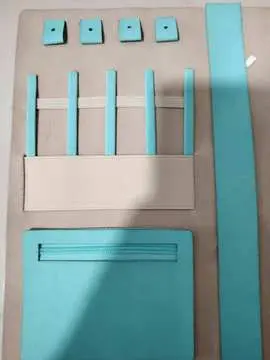
On July 13, the revised version finally won approval. She sent: “Yes!!! This is good!”
But on July 22, after the first sample had already been shipped, I kept looking at it and feeling something was not quite perfect. So I made a decision even I didn’t expect — I personally made a new, improved version.
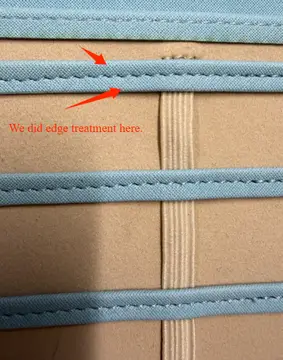
I recorded a video showing her the differences between the shipped sample and the improved version in my hand: logo position adjusted, exterior button style optimized, edge finishing more refined.
After watching the video, Bliss said: “Yes your video is the one we would like to have as the final.”
The only concern she had about the improved version was some black marks inside the inner page. I was honest: it was machine grease from hand crafting. In bulk production with molds, this wouldn’t be an issue at all. She trusted me.
Chapter 6: The Order — 76 Days Pay Off
July 23. Bliss confirmed all three colors — Pink (H322-07), Green (H322-14), Blue (H322-17) — and placed an order for 1,000 pieces.
On July 28, I sent the formal quotation:
| Item | Detail |
| Unit Price | $*****/pc (EXW) |
| Quantity | 1,000 pcs |
| Sea Freight | $765 |
| FINAL TOTAL | $******* |
For the second order onwards, with mold costs already amortized, the price will be even lower.
Epilogue
76 days. From an AI-generated “dream” to a real, shippable product.
Along the way, some numbers worth remembering:
| 76 | Days from first “Hello” to order confirmation |
| 66 | Images exchanged in our chat log |
| 13 | Modification requests from the first sample feedback |
| 2 | Full sampling rounds (one had to be completely redone due to craftsman error) |
| 1 | Improved version I personally made — after the sample was already shipped |
| 3 | Colors x 1,000 pcs = the final order |
People ask me: is it worth taking on such a complex custom order?
My answer: absolutely.
Not because of how much we made on this single order — the first order’s margin is thin, with mold costs eating up most of it. But because this entire process proved something fundamental:
AI can generate beautiful product images more easily than ever. But turning those images into something you can hold in your hands — with real texture, real function, and real perfection — that is the truly hard part. And that is where our value lies.
When other factories said “can’t be done” — we did it.
When the client sent 13 modification requests — we worked through every single one.
When the craftsman made a mistake — we didn’t settle. We tore it apart and started over.
When I felt the shipped sample wasn’t perfect enough — I made a better one with my own hands.
DiPam said she hopes for a long-term partnership. I believe her.